Sunday, February 05, 2006
Beethoven's Appassionata
Do we really need more recordings of it? Remainder bins are already bulging with it in every slice and flavor. Why record it again? Those are some of the questions teased out in an interesting short article on Beethoven's sonata and some recent recordings of it (Lugansky, Biss, Paik, etc). Read it here.

And on the topic of opera
One more opera related note. Check out curious career path of conductor Koo Jah-bom found here.
What's wrong with this picture?
That's the question asked over at "Sounds and Fury".
WTB says it looks, sort of, kind of, like John Waters meets opera. Just sayin... Not that that's bad per se.
(Edit: Little known fact. Somone once optioned to make an opera of Water's film "Pink Flamingos". Hmmmm. .. )
WTB says it looks, sort of, kind of, like John Waters meets opera. Just sayin... Not that that's bad per se.
(Edit: Little known fact. Somone once optioned to make an opera of Water's film "Pink Flamingos". Hmmmm. .. )
What if?
An interesting interview with pianist Toros Can is found here. I found one question most interesting and that was " You are given the position of artistic director of a concert hall. What would be on your program for this season?" Read the interview for Can's choices. Suffice it to say, I wasn't disappointed by them, but at the same time not surprised. It 's a familiar cast of characters.
Map It
UK music writer Dorian Lynskey has set down the history of Western music by mapping it along the London underground. As he sees it,"Pop intersects with everything else, so that had to be the Circle Line; classical music for the most part occupies its own sphere, which made it perfect for the Docklands Light Railway. There were a couple of false starts but by the end of one afternoon I had assigned genres to almost all the lines and thrashed out most of the major intersections."
A map of misreading in the best sense, no? Read about it here (includes a download .pdf of the map).
A map of misreading in the best sense, no? Read about it here (includes a download .pdf of the map).
Saturday, February 04, 2006
Schoolhouse Rock
NPR rockerati strike me as singularly clueless. Completely. Consistently.
But that's to be expected I suppose.
ON the topic of pop music, Alex Ross warns "pop and classical elitists alike should stay away" from an upcoming show with Doverman and Nico Muhly. Whaaaa !? Puhleeze, pop and classical elistists are likely to be the only ones attending.
Elsewhere in Rocklandia, Leif Garrett, former teen superstar turnedgrindy band musician, is in more trouble. According to news reports: " The '70s pinup was nabbed by police on Jan. 14 after he allegedly tried to ride a Los Angeles subway without purchasing a ticket. A subsequent search turned up heroin among his belongings."
Garrett fans can help out by downloading his song "Betty Ford for Xmas" via iTunes. Details on Garrett's website. Check out the site for some downloadable mp3's.
Snap, crackle, kranky. Go here, scroll to midpage, read and listen to the mp3. Poke around the website. It's good. And while you're out there, you might enjoy a listen to Godey and Creme singing "Sandwiches of You". Now that's tasty.
Be sure to have a go at Ghostbox. Check out the tasty treasures provided by The Focus Group. Like, this one *mp3.
But that's to be expected I suppose.
ON the topic of pop music, Alex Ross warns "pop and classical elitists alike should stay away" from an upcoming show with Doverman and Nico Muhly. Whaaaa !? Puhleeze, pop and classical elistists are likely to be the only ones attending.
Elsewhere in Rocklandia, Leif Garrett, former teen superstar turnedgrindy band musician, is in more trouble. According to news reports: " The '70s pinup was nabbed by police on Jan. 14 after he allegedly tried to ride a Los Angeles subway without purchasing a ticket. A subsequent search turned up heroin among his belongings."
Garrett fans can help out by downloading his song "Betty Ford for Xmas" via iTunes. Details on Garrett's website. Check out the site for some downloadable mp3's.
Snap, crackle, kranky. Go here, scroll to midpage, read and listen to the mp3. Poke around the website. It's good. And while you're out there, you might enjoy a listen to Godey and Creme singing "Sandwiches of You". Now that's tasty.
Be sure to have a go at Ghostbox. Check out the tasty treasures provided by The Focus Group. Like, this one *mp3.
Friday, February 03, 2006
Thursday, February 02, 2006
Housekeeping
Apologies are in order. I had somehow, unwittingly, enabled the "moderate comments" feature in Blogger. This resulted in all comments being sent to my email for approval. Unfortunately, it was directed to an email box that I do not frequently check (blame it on the spam).
I have changed this setting and all comments should now be appearing directly. I am trying to get thru the comments and requests (now scattered over a month's period) . So if you were wondering where your post went, it was resting in my inbox.
I have changed this setting and all comments should now be appearing directly. I am trying to get thru the comments and requests (now scattered over a month's period) . So if you were wondering where your post went, it was resting in my inbox.
Ergon
Something I wanted to touch on earlier was an exchange at Kyle Gann's fine blog PostClassic on the matter of "over-notation". You find it here. There are merits to be both sides. One thing Gann says is this:
"I have found a tremendous difference in responses to notation between performers who specialize in 20th-century music and those who play mostly Classical/Romantic repertoire, and far prefer the latter."
But, alas, my own experience leads me to prefer it the other way around.
------------------------------ "The notation is more important than the sound. Not the exactitude and success with which a notation notates a sound; but the musicalness of the notation in its notating." - Cornelius Cardew -----------------------------
(A) ORNSTEIN
And Sarah Cahill makes a well observed point about Leo Ornstein:
"Leo Ornstein... was an excellent pianist himself, and wrote fabulously for the piano. But most of his piano scores have absolutely no dynamic markings whatsoever. He believed that it was the pianist's responsibility to come up with dynamics in the process of interpretation. It's so interesting, because there will be a passage which to one person is a climax, to be played forte, and to another person it will be an opportunity to back off and have it be more powerful as a pianissimo passage. So his scores can be played in a variety of ways, and it's fascinating to hear different performances." More here.
I am very fond of Ornstein's music, so my attention was also caught by a post on Richard Scheinin's blog on Ornstein and Coltrane found here.
"Early in the 20th century, he was a superstar concert pianist and champion of new music. Later, in the '40s, he seems to have crossed paths with John Coltrane, the great jazz saxophonist, who turned out to be one of the century's most influential musicians."
(BTW, Scheinin has a splendid write up on the West Coast premiere of Ornstein's dazzling quintet for piano and strings.).
(B) CARDEW - Indeterminate notation
"Notation is a way of making people move" - Cornelius Cardew
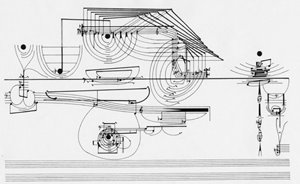
And coming back to the matter of notation, I thinking (really shadowed) by Cornelius Cardew's wild and gargantuan Treatise, a work that recently was heard in Vancouver. And well I image was Gann.
Pianist John Tilbury was rightly at the helm for the Vancouver performance. You can read about it here.
------------------------------
"The notation is more important than the sound. Not the exactitude and success with which a notation notates a sound; but the musicalness of the notation in its notating." - Cornelius Cardew
-----------------------------
(and while you're web surfing don't miss Tilbury's wonderful essay "On Playing Feldman". Choice graf: "When David Tudor or Cardew played Feldman what you heard and experienced with great intensity was the limb as it performed, the fingerpad - that most erotic part of a pianist's body - and the resulting sound was raw and thrilling. In too many performances one is all too conscious of a culture intervening between body and instrument." -Seeing how Feldman exists somewhere along the same exalted axis of aesthetic achievement as Bach (in my books at least), how could I not love that description.
You can listen to a spot of Cardew's lovely music by clicking here.
And if you've any taste for it (or at least have fond memories of reading Althusser) you can read Cardew's own "Stockhausen Serves Imperialism" here.
Or skip all that and visit the Block Museum virutal exhibit "Pictures of Music" It's a phenomenal site with much to see, hear, and read. It repays many visits.

"I have found a tremendous difference in responses to notation between performers who specialize in 20th-century music and those who play mostly Classical/Romantic repertoire, and far prefer the latter."
But, alas, my own experience leads me to prefer it the other way around.
------------------------------ "The notation is more important than the sound. Not the exactitude and success with which a notation notates a sound; but the musicalness of the notation in its notating." - Cornelius Cardew -----------------------------
(A) ORNSTEIN
And Sarah Cahill makes a well observed point about Leo Ornstein:
"Leo Ornstein... was an excellent pianist himself, and wrote fabulously for the piano. But most of his piano scores have absolutely no dynamic markings whatsoever. He believed that it was the pianist's responsibility to come up with dynamics in the process of interpretation. It's so interesting, because there will be a passage which to one person is a climax, to be played forte, and to another person it will be an opportunity to back off and have it be more powerful as a pianissimo passage. So his scores can be played in a variety of ways, and it's fascinating to hear different performances." More here.
I am very fond of Ornstein's music, so my attention was also caught by a post on Richard Scheinin's blog on Ornstein and Coltrane found here.
"Early in the 20th century, he was a superstar concert pianist and champion of new music. Later, in the '40s, he seems to have crossed paths with John Coltrane, the great jazz saxophonist, who turned out to be one of the century's most influential musicians."
(BTW, Scheinin has a splendid write up on the West Coast premiere of Ornstein's dazzling quintet for piano and strings.).
(B) CARDEW - Indeterminate notation
"Notation is a way of making people move" - Cornelius Cardew
And coming back to the matter of notation, I thinking (really shadowed) by Cornelius Cardew's wild and gargantuan Treatise, a work that recently was heard in Vancouver. And well I image was Gann.
Pianist John Tilbury was rightly at the helm for the Vancouver performance. You can read about it here.
------------------------------
"The notation is more important than the sound. Not the exactitude and success with which a notation notates a sound; but the musicalness of the notation in its notating." - Cornelius Cardew
-----------------------------
(and while you're web surfing don't miss Tilbury's wonderful essay "On Playing Feldman". Choice graf: "When David Tudor or Cardew played Feldman what you heard and experienced with great intensity was the limb as it performed, the fingerpad - that most erotic part of a pianist's body - and the resulting sound was raw and thrilling. In too many performances one is all too conscious of a culture intervening between body and instrument." -Seeing how Feldman exists somewhere along the same exalted axis of aesthetic achievement as Bach (in my books at least), how could I not love that description.
You can listen to a spot of Cardew's lovely music by clicking here.
And if you've any taste for it (or at least have fond memories of reading Althusser) you can read Cardew's own "Stockhausen Serves Imperialism" here.
Or skip all that and visit the Block Museum virutal exhibit "Pictures of Music" It's a phenomenal site with much to see, hear, and read. It repays many visits.